
Recent Developments
As the world situation has begun to change, foreign policy has also had to develop. The Norwegian government is in a constant state of revision, continually adapting to local, national, and international events. "Ei forandra verd = eit forandra Noreg," says Jon Lilletun, head of Vest-Agder Kristelig Folkepartiet, and his statement is true in every sense.1
One of the biggest problems with Norwegian refugee policy thus far has been the
long wait while applications for asylum are processed. The living
standards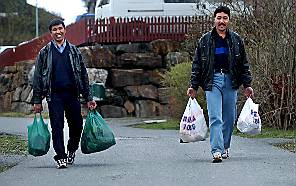 in the refugee centers are designed for stays of up to one year, but many
refugees stay longer. Health care is sometimes inadequate, and daily
activities vary greatly from center to center (some refugees attend school or
work; others merely sit and wait). Surveys have shown that refugees find
this wait to be the worst aspect of their journey2; the government has now
recognized this and has proposed a series of reforms. These reforms will
speed up case processing, declare new national goals for reception centers and
institute proper inspections at those centers, and consider different options
for financing health care (among many other things).3
in the refugee centers are designed for stays of up to one year, but many
refugees stay longer. Health care is sometimes inadequate, and daily
activities vary greatly from center to center (some refugees attend school or
work; others merely sit and wait). Surveys have shown that refugees find
this wait to be the worst aspect of their journey2; the government has now
recognized this and has proposed a series of reforms. These reforms will
speed up case processing, declare new national goals for reception centers and
institute proper inspections at those centers, and consider different options
for financing health care (among many other things).3
Two refugees enter Norway after two years in a UN refugee camp (Aftenposten)
Another case that
has emerged recently has been a policy regarding return to the home country.
Norway is one of the few European countries where, if a refugee or asylum-seeker
is forcibly removed from the country, the refugee must pay travel expenses,
including transportation, food, and housing, for themselves, their family,
and their police escort. The amount the
 refugee family pays is
generally left to the municipal police to decide, using the family's income as a
guide.4 However, this system was recently abused by a force of seven
police officers assigned to escort a Syrian family back to Damascus. While
on route, the police officers managed to spend 90,000 of the 100,000 kroner
given to the family as a gift by wealthier relatives in Norway.5 Because
of the uproar this caused within Norway's refugee community, this policy is now
also under revision.
refugee family pays is
generally left to the municipal police to decide, using the family's income as a
guide.4 However, this system was recently abused by a force of seven
police officers assigned to escort a Syrian family back to Damascus. While
on route, the police officers managed to spend 90,000 of the 100,000 kroner
given to the family as a gift by wealthier relatives in Norway.5 Because
of the uproar this caused within Norway's refugee community, this policy is now
also under revision.
Nearly 80% of the cases UDI handled in 2002 were either cancelled or delegated to other European lands6, and though this percentage is high, some of the Norwegian poeple would like to see it climb still further. The variations in belief that start to emerge, even among the government members, are striking. To read more on this topic, see the "Popular Opinion" portion of this web site.
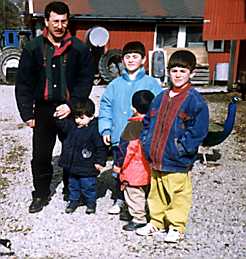
Mustafa and family before deportation (Aftenposten)
"Skal vi bevare oppslutningen om asylinstituttet, er det helt nødvendig å begrense tilstrømningen av grunnløse asylsøkere..."
~Erna Solberg, community minister of Norway7
"[De danske] skryter av at de har redusert antallet søkere, men det de egentlig har er en hardhendt politikk som ikke respekterer det faktum at det å søke asyl er en del av folkeretten."
~Bishop Gunnar Stålsett8
|
|
1 "A changed world = a changed Norway." Lilletun, Jon, "Innvandringspol - kva er det?", 18 March 2002, <http://www.krf.no/krfweb/politikk/nyheter/auto/20021018223844.asp> (23 April 2003)
2 Kommunal- og Regionaldepartementet, "Report to the Storting #17: Asylum and Refugee Policies in Norway", n.d., <http://odin.dep.no/krd/engelsk/publ/rapporter/016081-040002/index-dok000-b-n-a.html> (15 April 2003)
3 ibid.
4 Viken, Trond, "Brustad vurderer asylpraksis", Aftenposten, 23 September 2000, <http://tux1.aftenposten.no/nyheter/iriks/d163873.htm> (15 April 2003)
5 Holm, Per Annar, "Politiet tok 90 000 fra flyktninger", Aftenposten, 23 September 2000, <http://tux1.aftenposten.no/nyheter/iriks/d163205.htm> (15 April 2003)
6 UDI, "Vårkonferanse 2002: Asyl i krise?", 23 April 2002, <http://www.udi.no/default.asp?MenuID=3589&intStrukturID=11243&PubID=3509> (14 April 2003)
7 "Should we keep support for asylum as an institution, it would be entirely necessary to limit the rush of landless refugees [landless meaning that they have no place to go]." ibid.
8 "The Danes brag that they have reduced their total numbers of applicants, but what they actually have is a hard-headed policy that does not respect the fact that to seek asylum is a part of the rights one has as a human." ibid.