
Repatriation
"Return is an important element of a comprehensive refugee policy and has been a central element of Norwegian refugee policy during the 1990s."1 Many Norwegian refugees are granted an impermanent residence permit when they enter Norway seeking asylum; in fact, only 39,000 of the 84,000 refugees in Norway today have received citizenship.2 Upon the recommendation of the UN High Commissioner for Refugees, most comprehensive refugee programs in Europe include a return provision; the thought behind this is along the lines of the old adage, "East or West, home is best."
Norway provides a return program for its refugees, established in 1992, that covers travel expenses and individual support for those who will return to their country of origin.3 This program, designed to provide the means and motivation for return, provides 15,000 Norwegian kroner (approximately US $2,125) plus travel expenses to each refugee as they repatriate.4 This program also provides not only monetary support to the refugees, but also to programs within the Norwegian municipalities that are run to "keep the dream of the home country alive".5 Numbers have not been very high as of yet, but the government is encouraging return as a viable option.
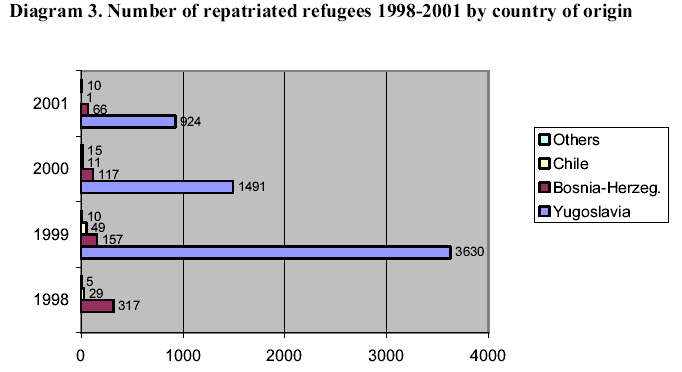
(diagram retrieved from Statistisk Sentralbyrå)6
Another factor encouraging voluntary repatriation is that it can be very difficult to return home for just a short while. It has always been difficult for the refugees to obtain a visitor's permit to travel home for a vacation, and finally, in winter of 2002, the UDI decided to stop approving visits for refugees to their country of origin. In an article published on 3 February 2003, the UDI warns that a return visit to one's homeland can lead to a re-evaluation of one's refugee status; "At en person har vært på besøk i hjemlandet kan være en indikasjon på at vedkommende ikke lenger fyller vilkårene for asyl slik at det kan bli aktuelt å vurdere tilbakekall av asylstatus".7 This decision is circumstantial; not every illegal visit home occasions an actual withdrawal of one's refugee status,8 but it is a risk not many are willing to take. As a result of this new policy, the government hopes that those whose homelands are no longer dangerous may choose repatriation in order to be reunited with family members in their home countries.
1 Kommunal- og Regionaldepartementet, "Report to the Storting #17: Asylum and Refugee Policies in Norway", n.d., <http://odin.dep.no/krd/engelsk/publ/rapporter/016081-040002/index-dok000-b-n-a.html> (15 April 2003)
2 Statistisk Sentralbyrå, "Tabell 2: Flyktninger, etter landsbakgrunn og botid i Norge. 1.januar 2001" 1 January 2001, <http://www.ssb.no/flyktninger/tab-2002-06-05-02.html> (5 April 2003)
3 Landsverk, Camilla, "SOPEMI Norway 2002: Trends of migration to and from Norway and the situation of immigrants in Norway.", <http://www.ssb.no/emner/00/00/10/innvstat/sopemi2002.pdf> (23 April 2003)
4 ibid.
5 ibid.
6 ibid.
7 "That a person has visited their homeland can be an indication that the person concerned no longer fulfills the requirements for asylum, such that it may be necessary to consider a withdrawal of their refugee status." UDI, "UDI godtar ikke asylferie i hjemlandet", 3 February 2003, <http://www.udi.no/default.asp?menuID=3037&intStrukturID=11243&ArtID=13322> (4 April 2003)
8 ibid.