
Residence and Work
To acquire Norwegian citizenship by an application, one must be at least eighteen years of age, have lived in Norway for at least 7 years, have no criminal record, and have no outstanding debts.1 However, these are not the only criteria. In order to live and work in Norway, one must be one of the following:2
 |
Students who have been admitted to an approved educational institution |
|
|
Persons who are considered specialists in a particular field |
|
|
Au pairs |
|
|
Seasonal workers |
|
|
Close family members (spouses and children) |
|
|
Persons who need protection (refugees) |
|
|
Trainees |
Having family members in Norway is generally a surefire way for refugees to guarantee placement, and later citizenship, in a
|
Irak |
1 817 |
|
Somalia |
727 |
|
Russland |
708 |
|
Thailand |
704 |
|
Pakistan |
631 |
|
Tyrkia |
541 |
|
USA |
446 |
|
Filippinene |
397 |
|
Afghanistan |
381 |
|
Vietnam |
360 |
Norwegian community. "The aim of the provisions on family reunification is to protect already established family ties."3 Though on a technical level only members of the immediate family fall under this provision, human considerations such as refugee status or age are also taken into account. Life partners are also included as members of one's immediate family. The chart to the left shows numbers of reunifications by country, in 2001; when you consider that these are out of a total of 11,000 refugees entering the country on the whole, these numbers are significantly larger.3.5
Naturalization is not encouraged or discouraged among refugees; it is merely presented as an option. SOPEMI, an annual report issued by the UDI, states: "In 2001 less than 2 per cent of nationals of Nordic, EEA and North American countries who qualified for Norwegian citizenship availed themselves of that opportunity, whereas nearly all Ukrainians, more than 80 per cent of Vietnamese and Yugoslavs and around 60 per cent of Bosnians, Bulgarians, Iranians and Philippines did it. This has been the usual pattern for many years; just a small percentage of Western European and Northern American citizens has naturalized, while the rates for all other countries are much higher."4 Though these statistics account for all immigrants into Norway, and not just refugees, the trend is obvious: those who have come to Norway as refugees choose to remain as Norwegian citizens; those who voluntarily moved do not. The chart below shows naturalization rates for refugees from several different countries over three years.
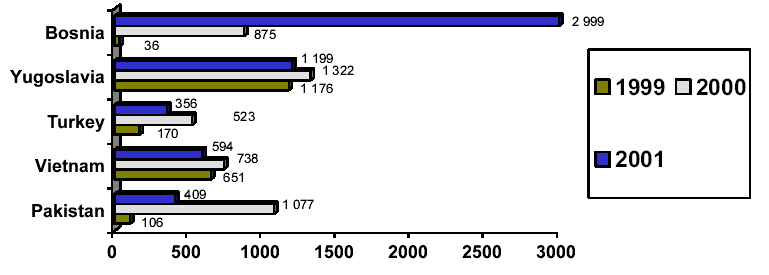
Chart courtesy of SOPEMI5
 One of the stated goals of Norwegian refugee policy is "helping refugees to
become self-reliant as quickly as possible".6
However, refugees have consistently had lower incomes and a higher rate of
unemployment than native Norwegians, regardless of the jobs they may have held
in their home countries. In 1999, refugees and other immigrants from Asia,
Africa, Turkey, and Central and South America made an average of 297,700 kroner
annually; the national average was 527,300 kroner.7
One of the stated goals of Norwegian refugee policy is "helping refugees to
become self-reliant as quickly as possible".6
However, refugees have consistently had lower incomes and a higher rate of
unemployment than native Norwegians, regardless of the jobs they may have held
in their home countries. In 1999, refugees and other immigrants from Asia,
Africa, Turkey, and Central and South America made an average of 297,700 kroner
annually; the national average was 527,300 kroner.7
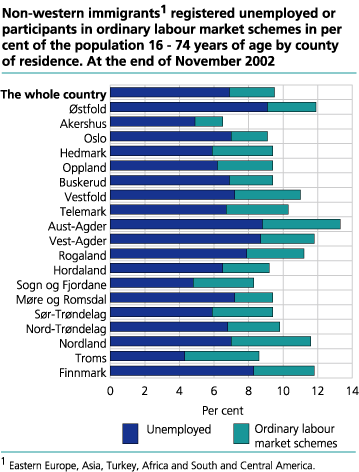
To work as a foreign national in Norway, one must hold a work permit. These permits have gradually become harder to obtain; in fact, permit reforms were instituted in 1975 as a method of curbing the level of unskilled immigration labor.8 Because of these restrictions, finding official work in Norway is difficult: one must have an definite offer of employment or a standardized service contract co-signed by a potential employer.9 It can be very difficult for refugees to find work in Norway; however, provisions are made in nearly every community to make work, however unskilled the work may be, available to these refugees.
Chart courtesy of Statistisk Sentralbyrå10
1 Landsverk, Camilla, "SOPEMI Norway 2002: Trends of migration to and from Norway and the situation of immigrants in Norway.", <http://www.ssb.no/emner/00/00/10/innvstat/sopemi2002.pdf> (23 April 2003)
2 UDI, "Residence and work", n.d., <http://193.71.11.42/default.asp?intStrukturID=11244&MenuID=3201&PubID=1919> (12 April 2003)
3 UDI, "Family reunification", n.d., <http://193.71.11.42/default.asp?intStrukturID=11244&MenuID=3126&PubID=1757> (12 April 2003)
3.5 UDI and Kommunal- og Regionaldepartementet, "12 000 familiegjenforeninger i 2001", 10 April 2002, <http://odin.dep.no/krd/norsk/publ/periodika/nb/016081-990050/index-dok000-b-n-a.html#2> (12 April 2003)
4 Landsverk, Camilla, "SOPEMI Norway 2002: Trends of migration to and from Norway and the situation of immigrants in Norway.", <http://www.ssb.no/emner/00/00/10/innvstat/sopemi2002.pdf> (23 April 2003)
5 ibid.
6 Kommunal- og Regionaldepartementet, "Report to the Storting #17: Asylum and Refugee Policies in Norway", n.d., <http://odin.dep.no/krd/engelsk/publ/rapporter/016081-040002/index-dok000-b-n-a.html>
7 Statistisk Sentralbyrå, "Table 4: Income components for families by family type and land background. Reference persons age 25-55. Average. 1999.", 29 August 2001, <http://www.ssb.no/english/subjects/05/01/inntinnv_en/tab-2001-08-29-04-en.html> (23 April 2003)
8 Landsverk, Camilla, "SOPEMI Norway 2002: Trends of migration to and from Norway and the situation of immigrants in Norway.", <http://www.ssb.no/emner/00/00/10/innvstat/sopemi2002.pdf> (23 April 2003)
9 ibid.
10 Statistisk Sentralbyrå, "Still increasing unemployment", 20 February 2003, <http://www.ssb.no/english/subjects/06/03/innvarbl_en/> (22 April 2003)